Hydrate-eating worms
The SwarmThe Hydrate-eating worms are anomalous polychaetes whose observed burrowing turns a small-scale biological puzzle into a geological threat. In experiments, they bore into methane hydrate in apparent pursuit of bacteria, but die when they reach trapped gas and lose access to oxygen. Later, the novel connects the worms, together with bacteria, to the conversion of stable hydrate deposits into brittle material; their activity becomes part of the chain leading to a massive continental-slope collapse. The creature’s significance lies not simply in its unusual behavior, but in the way that behavior reveals how life in the deep sea can participate in planetary-scale change.
Identity and Deep-Sea Setting
The worms are studied as polychaetes associated with hydrate deposits on the continental slope. Their habitat belongs to a boundary between familiar and poorly understood marine space: continental shelves are comparatively shallow underwater extensions of land, while the seafloor beyond them descends toward a less accessible oceanic world. The worms’ connection to methane hydrate places them not in an ordinary seabed environment but in deposits whose stability depends on conditions in the deep ocean.
The experiment distinguishes these animals from worms that merely live on hydrate surfaces. Heiko Sahling explains that, in theory, worms should remain on the upper layer, melt only a centimetre or two of ice, and live there with their symbiotic bacteria. The specimens’ large jaws, however, make that account inadequate. Their behavior suggests an attempt to reach bacteria deeper within the hydrate, even though the apparent route toward a food source exposes them to lethal conditions.
The organisms are also part of the book’s accumulating pattern of marine anomalies. A brief inventory places bristleworms in Norway alongside Portuguese men-of-war in South America and box jellyfish in Australia. That juxtaposition does not establish that the worms cause the other incidents, or that all the events share a demonstrated mechanism. It does place the Norwegian discovery within a widening catalogue of disturbances that characters initially struggle to interpret as connected.
The Simulation and Its Results
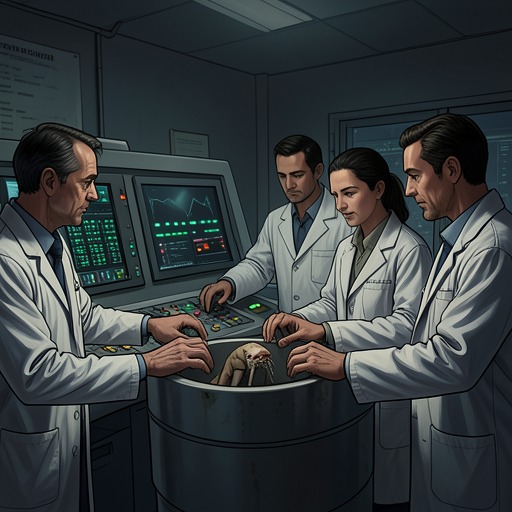
At the GEOMAR Centre, Gerhard Bohrmann’s team studies the worms in a large simulation chamber. A semicircular control station receives images from twenty-two cameras inside the tank, while measurements are continually taken throughout it. The scientists have placed two polychaetes on hydrate deposits. On the monitors, the worms move across the ice and then one stops; wave-like motion passes through its body before it disappears beneath the surface. Another specimen extends its proboscis, exposing its jaws.
The burrowing is striking but not, by itself, proof of what the worms are seeking. As Johanson watches the specimens dig into the hydrate, the proposed explanation is that they are trying to reach bacteria buried farther inside. The holes they leave remain visible after the animals have disappeared beneath the ice. When the researchers check on them, both are dead. Sahling identifies oxygen deprivation as the immediate problem: the worms need oxygen, and the methane pocket they enter does not provide it. Their symbiosis depends on an exchange in which the bacteria supply nutrients and the worms supply oxygen; burrowing too far cuts the worms off from the conditions that sustain them.
Follow-up trials repeat and refine the observation. GEOMAR scientists introduce six more specimens into the chamber, and all burrow head-first into the ice. By contrast, two worms placed on sediment without hydrates neither eat nor burrow. Two others placed on hydrate-free sediment above a gas pocket do not dig, though they become agitated. Together, these trials make the hydrate itself important to the observed burrowing response, while leaving the exact behavior and its triggers in the wild unresolved.
The deaths in the chamber are not treated as a complete explanation of the animals’ natural limits. Its hydrate layer is only about two metres thick, whereas natural deposits on continental slopes may measure tens or even hundreds of metres. Gerhard Bohrmann considers it unlikely that the worms could dig more than three or four metres in the wild, but the simulation cannot establish how far they would actually penetrate under natural conditions. The experiments therefore provide a warning and a working hypothesis, not a definitive account of what the animals can do on the seabed.
From Burrowing to Slope Failure
The broader danger emerges when researchers consider the worms’ activity alongside methane hydrate stability. Bohrmann explains that warming can destabilize large hydrate deposits; slope collapses expose further deposits, releasing more methane. Because methane has a much greater global-warming potential than carbon dioxide, this release can increase warming, which in turn encourages further dissociation. He describes a feedback in which the consequences of hydrate destabilization intensify the conditions that produce it.
The worms initially appear too small to account for such a change. The expected arrangement has them working only at the uppermost layer, but their observed burrowing challenges that reassuring model. Later, as the crisis approaches, Yvonne Mirbach describes a nonlinear process: ice crumbles, gas rises from within it and fractures more hydrate, and the seabed begins to collapse. Her estimate that the critical event could be weeks, days, or sooner remains uncertain, but the evidence points toward a rapidly escalating hazard that the scientists cannot prove in advance.
The eventual collapse gives the biological observation its catastrophic consequence. Hydrates transformed by worms and bacteria from stable icefields and veins into porous, brittle material disintegrate across 150 kilometres of the slope. Water and methane escape explosively; gas breaks through rock, the shelf rises and slides, and successive failures draw more of the seabed into motion. The collapse becomes a chain reaction, with debris reducing remaining stable layers to mud. The worms are thus part of a causal system in which small-scale biological activity contributes to the destabilization of a vast geological structure.
Narrative and Ecological Significance
The investigation makes the worms’ apparent self-destruction consequential beyond the laboratory. Their behavior first reads as an evolutionary or physiological contradiction: they penetrate the very material that provides access to bacteria, yet the narrow hole and gas pocket deprive them of oxygen. The later catastrophe does not resolve that contradiction into purposeful action. Instead, it shows how an organism’s local behavior can have consequences vastly larger than the animal itself, especially when it interacts with a volatile geological system.
The novel also uses the experiments to distinguish observation from prediction. Cameras record burrowing, and the chamber tests show a contrast between hydrate-bearing and hydrate-free conditions. But those controlled results cannot establish the worms’ maximum depth in the wild or precisely forecast when the slope will fail. The gap between what scientists can see and what they can safely infer becomes part of the threat: the seabed is not directly visible, the deposits exceed the scale of the model, and a nonlinear process may accelerate before certainty is possible.
That gap gives the Hydrate-eating worms a particular place in the book’s changing sense of the ocean. The deep sea is not an empty backdrop beneath human activity: its living organisms, chemical deposits, and unstable slopes interact. The worms’ importance is therefore both biological and narrative. They make a hidden process legible in the laboratory, then expose the limits of laboratory knowledge when that process unfolds across an immense, poorly observed seabed.